

The Future of Financial Advisory: Collaboration Between AI and Human Advisors
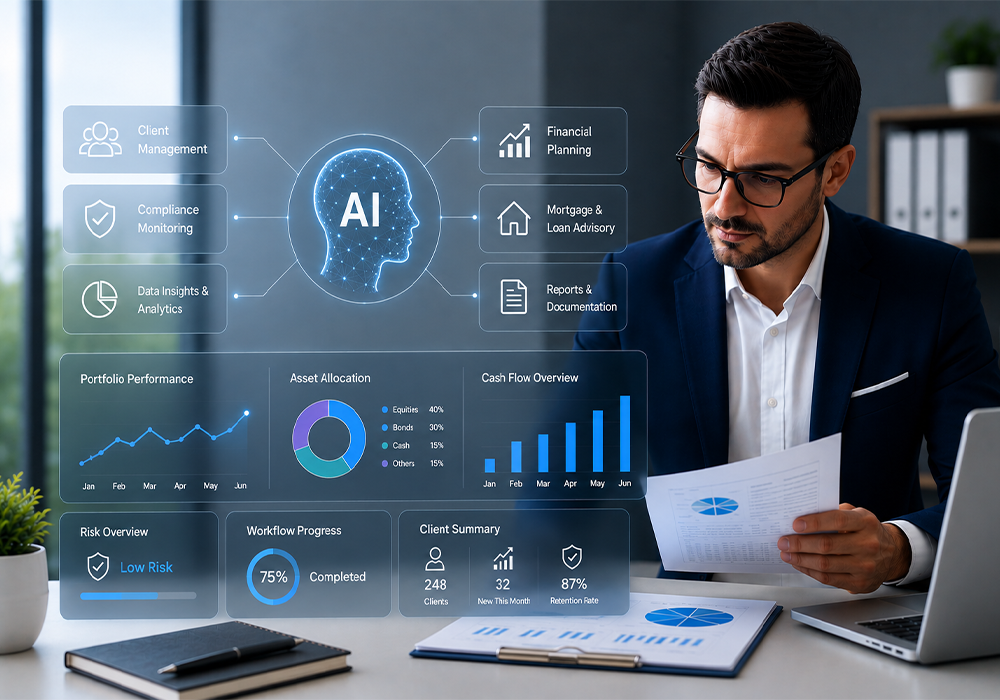
The financial services industry is undergoing a significant transformation as artificial intelligence (AI) becomes increasingly integrated into everyday business operations. From data analysis and compliance monitoring to document preparation and workflow automation, AI-powered tools are helping firms improve efficiency, accuracy, and scalability. However, while technology continues to evolve, the core principles of financial advice remain unchanged. Clients still rely on experienced professionals to provide strategic guidance, apply professional judgement, and navigate complex financial decisions.
The future of financial advisory is not defined by technology alone. Rather, it lies in the effective integration of AI capabilities with human expertise to deliver better outcomes for clients and businesses alike.
A New Era of Financial Services
Advancements in technology have transformed the way financial information is collected, processed, and analysed. Cloud-based platforms, machine learning algorithms, and automation tools now enable financial services firms to manage large volumes of data more efficiently than ever before.
For accounting firms, financial planning practices, SMSF administrators, and mortgage brokerages, these innovations have streamlined administrative processes, improved operational efficiency, and reduced the time spent on repetitive tasks. As a result, professionals can dedicate more attention to activities that require critical thinking, strategic insight, and client engagement.
While technology can process information quickly and accurately, it remains most effective when combined with human oversight and expertise. The firms that are embracing this approach are creating stronger, more scalable business models while continuing to deliver high-quality client outcomes.
How AI is Supporting Financial Professionals
AI is increasingly being adopted across various areas of financial services to support efficiency and improve service delivery.
SMSF Administration
AI-powered systems can assist with transaction reconciliation, compliance monitoring, data validation, and preliminary reporting. These tools help streamline administrative processes and reduce manual workloads. However, experienced SMSF professionals remain essential for interpreting regulatory requirements, reviewing outputs, and ensuring ongoing compliance with legislative obligations.
Paraplanning
AI can support paraplanners by assisting with data collection, research, document structuring, and the preparation of Statement of Advice templates. While these capabilities improve efficiency, experienced paraplanners continue to play a critical role in analysing client circumstances, identifying strategic opportunities, and ensuring recommendations align with a client’s goals and objectives.
Tax and Income Tax Return Preparation
Automation can assist with organising financial information, identifying potential deductions, validating calculations, and preparing tax returns more efficiently. However, Australia’s tax environment remains complex and subject to ongoing legislative change. Qualified tax professionals provide valuable expertise in interpreting legislation, managing complex scenarios, and developing effective tax strategies tailored to individual client needs.
Loan Processing
Technology can streamline document collection, serviceability assessments, and preliminary lending analysis. Mortgage professionals then apply their market knowledge, lender expertise, and understanding of client circumstances to identify suitable lending solutions and support clients throughout the borrowing process.
Across each of these functions, technology enhances efficiency while professionals contribute the expertise, judgement, and personalised guidance that clients value.
The Growing Importance of Human Expertise
As routine and administrative tasks become increasingly automated, the value of uniquely human skills continues to grow.
Financial professionals are increasingly expected to provide more than technical expertise. Clients seek trusted advisors who can explain complex concepts, evaluate options, identify risks and opportunities, and provide guidance during important financial decisions.
Professional judgement, critical thinking, communication, and relationship management remain central to delivering effective financial advice. These capabilities cannot be automated and continue to play a vital role in helping clients achieve their financial objectives.
The Skills That Will Define Future Advisors
The financial professionals of tomorrow will combine technical expertise with a strong understanding of emerging technologies.
Key skills likely to become increasingly important include:
- Strategic thinking and problem-solving
- Professional judgement
- Communication and client engagement
- Relationship management
- Regulatory and compliance knowledge
- Data interpretation and analysis
- Adaptability to technological change
By leveraging technology effectively while continuing to develop these core capabilities, advisors can enhance both the quality and consistency of the services they provide.
Why Outsourcing Can Support Transformation
As firms seek to improve efficiency and embrace new technologies, outsourcing specialist functions can provide a practical and scalable solution.
Partnering with an experienced outsourcing provider enables firms to access skilled professionals, established processes, and technology-enabled support without the need for significant internal investment. This approach can help businesses improve productivity, reduce operational costs, and maintain service quality while focusing on client relationships and business growth.
At Eternix Global, we support Australian accounting firms, financial planners, mortgage brokers, and SMSF specialists through a combination of industry expertise, proven processes, and technology-enabled solutions. Our team of more than 150 professionals works alongside clients to enhance operational efficiency while maintaining the high standards expected within the financial services industry.
The Future is Collaboration
The future of financial advisory will be shaped by organisations that successfully combine technological innovation with professional expertise.
AI offers significant opportunities to improve efficiency, streamline processes, and enhance decision-making. At the same time, human expertise remains essential for providing strategic guidance, exercising professional judgement, and building trusted client relationships.
Firms that embrace both technology and people will be better positioned to adapt to changing client expectations, navigate increasing complexity, and achieve sustainable long-term growth.
By integrating advanced technology with experienced professionals, financial services businesses can create a future that is more efficient, more responsive, and ultimately more valuable for the clients they serve.